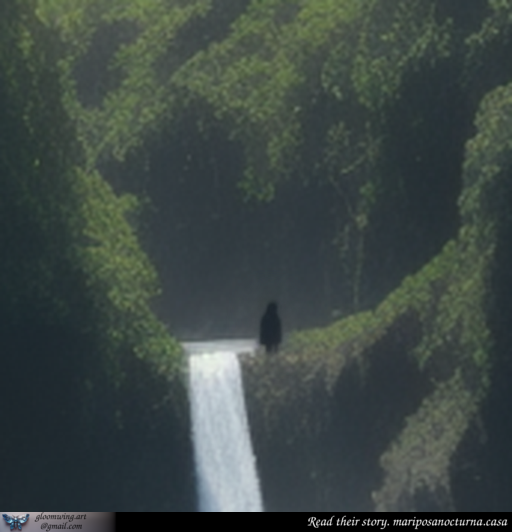
As I stopped to rest, suspending my gaze on the falling water, I noticed movement at the top of the cascade. At first, the figure didn’t fit into my mind’s idea of anything dangerous, but after a moment, it dawned on me – it was a human silhouette. Fear gripped me, and without thinking, I turned and ran, though I’m not proud of this display of my bravery. I didn’t stop until I reached the main river, where I finally dared to turn around. Nothing was chasing me. When I reached my belongings, my breath had steadied somewhat. I gathered my things and returned to the campsite.
When I arrived, I happened to catch the moment when my fellow campers were just beginning to eat the meals prepared by our guides. Focusing on inventing an excuse, in case someone noticed what I’d gone through, I mindlessly fell into the rhythm of packing and preparations.
Now, as I sit in peace, writing down my memories, I’m increasingly inclined to believe that it was all merely a trick of my imagination. Though I did have a waterfall bath, the experience of that moment remains elusive – a shadow of a story I can’t quite pin down.
When we set off on the road, we walked in the same direction as my morning excursion, and though I was looking for it this time, I didn’t find the path I had taken to reach the river. Along the way, I noticed a stone by the path that could have been the very stone that marked my trail, though I didn’t see the path itself. We arrived at the river in a completely different place-one sheltered, where the river spread out into a much shallower stretch. I didn’t ask our guides about my experience-mainly because I couldn’t even describe it in a way that would convince myself, let alone others, that it wasn’t an illusion. I processed this experience throughout the rest of the journey, and unfortunately, I didn’t reach any new conclusions. Now, as I write these words, I feel a deep sense of something I should subject to further verification, but without any fear.
13th day of journey
In the following days, the diary shifts from personal reflections to a description of a longer journey leading to the archaeological site. This site lies in a dense forest, about 20 days' walk from the station. The diary describes the difficulties of the journey, the paths thick with vegetation, river crossings, and encounters with wild animals.
The diary contains detailed descriptions of various animals and plants that reflect the diversity of Africa's ecosystems. One such species is the African golden cat (Caracal auratus), also known as the golden cat. This medium-sized predatory species of the felid family, reaching up to a meter in length and weighing up to 16 kg (33 lbs). Its fur, reddish-brown or gray, is often spotted and inhabits the continent's forests. It feeds primarily on rodents, but also birds and small mammals. In captivity, the mother gives birth to two kittens, and the species is threatened by hunting and habitat destruction.
This animal is one example of how the diary's descriptions encompass both predatory animals and plants that play a crucial role in ecosystems. For example, the candelabra spurge (Euphorbia candelabrum) is a succulent plant from the spurge family, found in the wild in Africa. Its name comes from its distinctive shape, which resembles a candelabra. This plant, though little known, is an important natural feature, often found in humid areas.
Another interesting description is of the African buffalo (Syncerus caffer), one of the largest herbivores in the bovidae family. Its origins remain unclear, and it is not closely related to the Asian domestic buffalo. This species was never domesticated, and its forest subspecies is half the size of the typical buffalo. Buffalo are a key component of African ecosystems, but their populations are threatened by environmental changes and human activity.
These descriptions, though only excerpts from the memoir, demonstrate the author's appreciation of the diversity of life on the continent. Every form of life-from the tiny golden cat to the mighty buffalo-is highlighted, underscoring her depth of understanding and respect for nature.
During the trip, several conversations took place with locals. One of them, a local guide, recounted the traditional method of fish farming in the canals that were part of the irrigation system. Another, a trader, described how his generation always carried a piece of oak wood, considered cursed, to ward off malicious spirits. The final conversation was with an elderly man who recounted a legend about a forest spirit that inhabits the bodies of those who disrespect nature.